MEWP (Mobile Elevated Work Platforms)
MEWP Standards & Certification Update
CSA (ISO) has updated the standards for Mobile Elevated Work Platforms. These platforms are also known as EWP, AWP, Scissor Lifts, Boom Lifts, Personnel Lifts, Genie, and JLG equipment.
The two updated standards that affect our clients are:
- CAN/CSA-B354.8:17 — Operator training for mobile elevating work platforms
- CAN/CSA-B354.7:17 — Safety principles, inspection, maintenance and operation
Because of these changes, Touchback Safety has updated our OHS Compliant MEWP program. Therefore, our program now meets the new CSA standards for Primary Training and Practical Evaluation.
Which Course Do You Need?
It is important to select the correct course when registering. If you work on an Oil Sands site, or are associated with a BTA Union, an ESC certification is mandatory. So always verify with your employer or worksite before booking.
However, if you are unsure which course applies to you, contact us and we will help you choose the right one.
OHS Compliant MEWP :
Includes both Boom and Scissor Lift Practical (Group A & B Type 3).
Valid Fall Protection certificate is a prerequisite
MEWP Training – Edmonton & Alberta
Our OHS Compliant MEWP course is $195.00 per participant.
We offer both in-facility and on-site training options. On-site training is available for any Group or Type of MEWP. However, you must specify which type of MEWP you need certification for when booking.
For on-site training in Edmonton, a minimum of eight participants is required. For locations outside of Edmonton, additional travel costs will apply.
Blended Learning Option Available
This course is also available in a Blended Learning format. Blended learning combines online theory with hands-on practical training. Therefore, it works best for workers who already have experience operating MEWPs.
Because it moves faster, blended learning suits experienced operators well. However, new workers will benefit more from our full Instructor Led course. So if your team is new to MEWPs, we recommend the instructor led option.
Energy Safety Canada
ESC MEWP Course – $195.00 per participant
The practical portion of this course is completed on a Boom Lift (Group B – Type 3).
⚠️ Important Registration Requirement
An ESC Fall Protection certificate is required to register for this course. We do not accept other certificates, including BTATS.
Because of this requirement, please ensure you have the correct certificate before registering. If you register without a valid ESC Fall Protection certificate, you will be ineligible to attend. Also please note that fees are non-refundable in this situation.
So before you book, double check that your certificate meets the ESC requirement.
____________________________________________________________________
NEW CLASSIFICATIONS of MEWPs
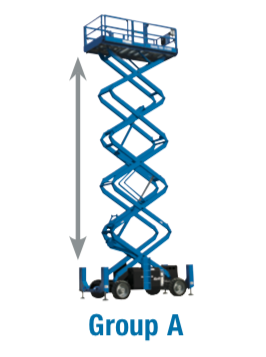
Group A – centre of the work platform remains within the perimeter of the chassis at all times
Scissor lifts – Vertical lifts
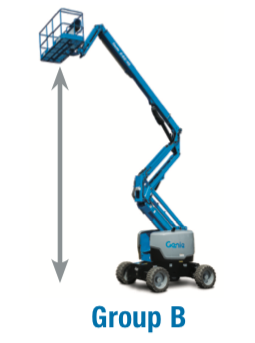
Group B – Center of the work platform can be positioned beyond the chassis
Boom lifts
New MEWP Classifications Explained
CSA has introduced new classifications for all MEWPs. Therefore, it is important to understand which group and type applies to your equipment.
Group A — Scissor Lifts
The centre of the work platform stays within the perimeter of the chassis at all times. Scissor lifts are vertical lifts that fall into this group.
Group B — Boom Lifts
The centre of the work platform can extend beyond the chassis. Boom lifts fall into this group.
MEWP Types at a Glance
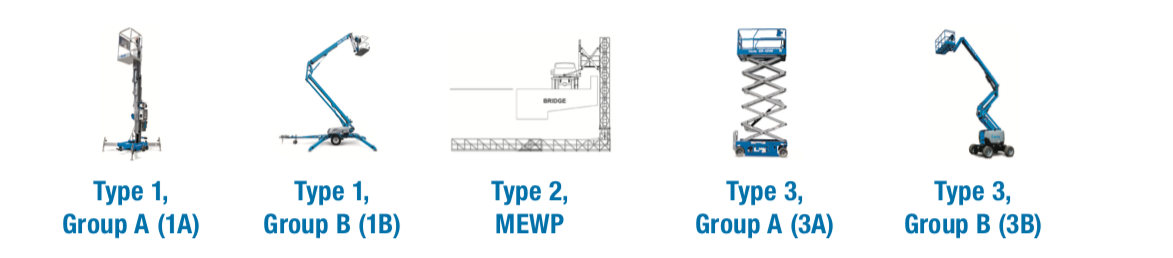
- Type 1: Moves only in the stowed position and requires manual movement. Example: Personnel or push-around lifts.
- Type 2: Can travel while elevated, but operators control it from the chassis. Example: Under-bridge inspection machines.
- Type 3: Has controls on the work platform and operators can drive it while elevated. Example: Booms and scissors.
What the New Standards Mean for You
The new standards affect all MEWP users, owners, operators, and supervisors. Because of this, owners and users now carry more responsibility than before.
OH&S regulations require supervisors to be competent in supervising workers who use MEWPs. However, the new CSA standards do not require supervisors to complete formal operator training. Instead, an examiner must complete a familiarization and competency check with each worker.
Once a worker completes their training, they must complete a familiarization and competency check with their employer’s designated examiner. This check applies to each specific make and model of MEWP that falls under their certification classification.
Feel free to use our Sample forms or for reference to create your own with the provided links below.
Familiarization Requirements (CSA B354.8:17 — 6.2)
Before an operator uses a specific make or model of MEWP, a qualified person must provide familiarization on the following:
- Location of the operator manual
- Manufacturer-specific warnings and instructions
- Specific control functions
- Function of each safety feature
- Operating characteristics
- Verification of the annual inspection
Examiner Requirements (CSA B354.8:17 — 7.3)
A MEWP examiner must be a qualified person. They provide familiarization and practical evaluation. However, an examiner does not need to deliver operator theory training. The examiner must have the following knowledge and experience:
- Experience as a qualified MEWP operator in the relevant classifications
- Knowledge of the practical evaluation process
- Ability to demonstrate and evaluate pre-start inspections
- Knowledge of risk assessments and workplace inspections
- Knowledge of safe use requirements under CSA-B354.7
Occupant Training Requirements (CSA B354.8:17 — 6.5)
The MEWP operator must instruct all occupants and ensure they have a basic level of knowledge to work safely. Occupant instruction must cover at minimum:
- Use of fall protection and anchorage points
- Factors that affect stability
- Safe use of accessories
- Site-specific work procedures for MEWP use
- Avoidance of hazards identified in the risk assessment
- General knowledge of controls, features, and emergency shutdown procedures
- Manufacturer warnings related to the work activity
- Location of the operator manual
When Do Operators Need Retraining? (CSA B354.8:17 — 7.4)
One of the most common questions we receive is: do current operators need retraining? The answer depends on their previous training and how often they operate the equipment.
Because Touchback Safety courses have always included manufacturer requirements, OH&S regulations, and ANSI standards, many of our clients already meet the new requirements.
However, retraining is necessary in the following situations:
- The operator’s training certificate has expired
- Proficiency has deteriorated
- An accident or near miss has occurred while operating a MEWP
- Workplace conditions have changed in a way that affects safe operation
- New MEWP technologies or working methods are in use
Additional Requirements for All MEWP Users
All MEWP users must be aware of the following requirements. These apply to everyone who uses, owns, or manages MEWPs on a worksite:
- All MEWP users must develop a risk assessment and site safety plan before use.
- Someone on the ground must be able to act as an operator in the event of an unexpected malfunction or emergency.
- Maintenance personnel must receive training on new features such as tilt sensors, wind speed sensors, and load limit alarms.
- Attendance personnel must conduct annual inspections, and also inspect MEWPs that have been out of service for more than three months.
- New aerial lifts must include sensors that sound an alarm and prevent operation when the safe load limit is exceeded. A tilt sensor must also trigger an alarm when a certain slope is exceeded.
- Chains to close work platform entrances are no longer permitted. MEWPs must have a gate complete with toe guards.
Book Your MEWP Training in Edmonton Today
Touchback Safety has delivered industry-leading MEWP training since 1999. Therefore, you can trust our team to keep your workers safe and your worksite compliant.
We serve Edmonton and all of Alberta. So whether you need one participant certified or an entire crew trained on-site, we have a solution for you.
Contact us today to book your course or request a quote.
